
Full-Funnel Digital Marketing Strategy (Awareness to Conversion)
Learn how to build a full-funnel digital marketing strategy using STP, BCG Matrix, AIDA, and TOFU-MOFU-BOFU to turn awareness into conversions.

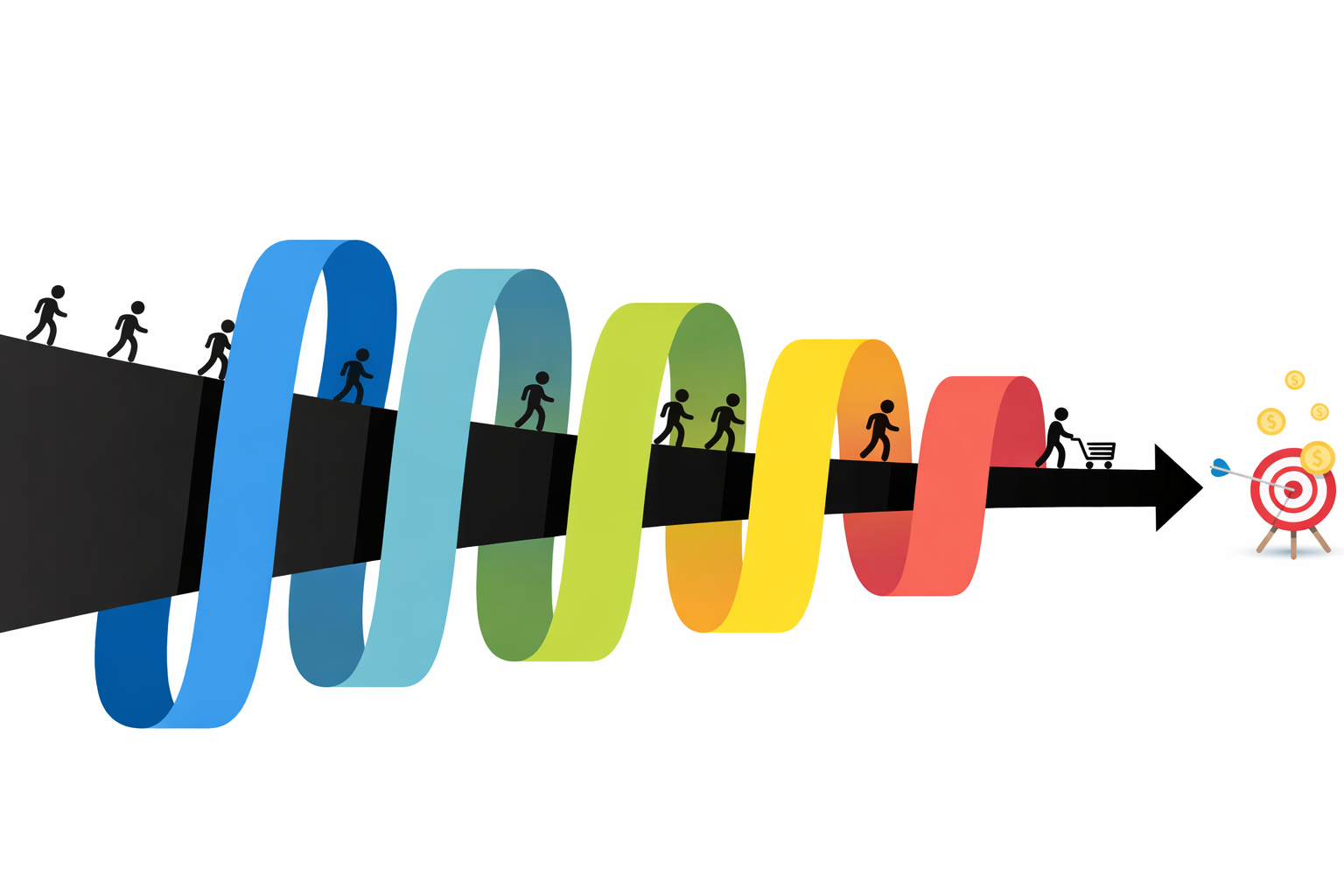
Most digital marketing fails not because the ads are bad or the content is weak. It fails because the strategy is incomplete. Brands pour money into awareness campaigns and wonder why sales don't follow. Or they retarget people aggressively without ever building trust first. The fix is thinking in funnels.
A full-funnel digital marketing strategy maps every stage of the customer journey, from the moment someone first hears about you to the moment they buy. And to build one that actually works, you need to lean on proven frameworks like STP, TOFU/MOFU/BOFU, AIDA, and the BCG Matrix. Here is how they all fit together.
Step 1: Know Who You Are Talking To (STP Model)
Before you build a funnel, you need to know who it is built for. That is where STP comes in. STP stands for Segmentation, Targeting, and Positioning, and it is the foundation of any smart marketing strategy.
- Segmentation means dividing your market into groups based on shared characteristics. These could be demographic (age, income, location), psychographic (values, interests, lifestyle), or behavioral (purchase history, brand loyalty, usage patterns). For example, a fitness brand might segment its audience into weekend warriors, competitive athletes, and people just starting their health journey.
- Targeting means choosing which segment(s) to focus on. You cannot speak to everyone effectively. Trying to do so means you end up speaking to no one. Pick the segment where you have the strongest product-market fit and where your marketing budget will go furthest.
- Positioning means defining how you want your brand to be perceived within that target segment. Are you the affordable option? The premium one? The most innovative? Your positioning shapes every piece of content, every ad, and every landing page you create.
Without STP, your funnel has no direction. It is like building a road without knowing the destination.
Step 2: Use the BCG Matrix to Prioritize Your Channels
Not all marketing channels deserve equal investment. The BCG Matrix, originally designed for product portfolio management, is surprisingly useful here. It divides things into four quadrants: Stars, Cash Cows, Question Marks, and Dogs.
- Stars are high-growth, high-performing channels. If your Instagram Reels are driving massive reach and engagement, that is a Star. Put more fuel into it.
- Cash Cows are steady performers with lower growth but reliable results. Email marketing often falls here. It may not be exciting, but it converts. Do not neglect it.
- Question Marks have potential but are unproven. Instagram Threads, for instance, is still finding its footing as a platform and it is unclear how well it converts for most brands. You need to test and gather data before committing heavily. Even LinkedIn, depending on your niche, can fall here. The audience exists but whether it converts for your specific business is still unclear.
- Dogs are low-growth and low-performing. If your Twitter/X posts consistently get zero traction and drive no leads, that is a Dog. Cut your losses and reallocate.
Applying the BCG lens to your channel mix ensures you are not wasting budget on vanity efforts while starving your best performers.
Step 3: Build the Funnel with TOFU, MOFU, and BOFU
Now comes the core of your strategy: the funnel itself. Digital marketers break it into three zones, top of funnel (TOFU), middle of funnel (MOFU), and bottom of funnel (BOFU).
-
TOFU: Top of Funnel (Awareness) At the top, people do not know you exist or they barely know they have a problem you can solve. Your job here is not to sell. It is to get noticed and earn attention. TOFU content includes blog posts, YouTube videos, social media content, podcast appearances, influencer partnerships, and paid awareness ads. The goal is reach and relevance. SEO-driven blog content works especially well here because it catches people right when they are searching for answers. Metrics that matter at TOFU: impressions, reach, new website visitors, video views, and brand search volume.
-
MOFU: Middle of Funnel (Consideration) Once someone knows you exist, you need to keep them interested and build trust. MOFU is where you educate, nurture, and differentiate yourself from competitors. MOFU content includes email newsletters, webinars, comparison guides, case studies, retargeting ads, and free tools or calculators. This is where you prove you understand the customer's problem better than anyone else. Metrics that matter at MOFU: email open rates, content downloads, webinar sign-ups, time on site, and retargeting click-through rates.
-
BOFU: Bottom of Funnel (Conversion) At the bottom, the prospect is ready to decide. They are comparing you against one or two alternatives. Your job is to remove friction and give them one final reason to choose you. BOFU tactics include free trials, demos, discount offers, testimonials, live chat support, and strong call-to-action landing pages. This is where your sales team or your checkout flow takes over from marketing. Metrics that matter at BOFU: conversion rate, cost per acquisition, trial-to-paid ratio, and revenue.
Step 4: Apply AIDA to Every Piece of Content
- AIDA is one of the oldest marketing models and it still holds up. It stands for Attention, Interest, Desire, and Action. Think of it as a mini-funnel inside every single piece of content you create. Attention is about the hook. In a crowded feed, you have about two seconds. A strong headline, a striking visual, or a bold opening line is the difference between a scroll and a stop.
- Interest is where you hold them. Once you have got their attention, give them a reason to keep reading or watching. This usually means speaking directly to a pain point or a goal they care about.
- Desire is where you shift from informing to persuading. This is where social proof, before-and-after stories, and specific outcomes come in. You are not just describing your product. You are helping them picture their life with it.
- Action is the close. Every piece of content should have one clear next step. Subscribe, download, book a call, add to cart. Do not leave the audience wondering what to do next.
A landing page that nails AIDA can outperform a technically perfect page that ignores psychology. This model applies whether you are writing a Google Ad (which has all four elements compressed into three lines) or a 2,000-word sales page.
Putting It All Together: A Real-World Example
Say you are launching a project management SaaS tool targeting small marketing agencies. Here is how the frameworks stack up in practice.
-
You start with STP. Your segment is marketing agencies with 5 to 20 people. Your target is founder-led agencies that are scaling and feeling the chaos. Your positioning is the most intuitive tool built specifically for agency workflows, not just another general-purpose PM app.
-
You use the BCG Matrix to assess your channels. SEO and content marketing are your Stars because search intent is strong and CAC is low. Email drip campaigns are a Cash Cow. Paid LinkedIn ads are a Question Mark you will test. Facebook ads are a Dog for your audience so you skip them.
-
You build your TOFU with blog content targeting searches like how to manage multiple client projects or agency workflow tips. At MOFU, you retarget blog readers with a free agency project tracker template download, pulling them into an email sequence. At BOFU, they get a personalized demo invitation and a 14-day free trial with onboarding support.
-
Every blog post, every ad, and every email is written using AIDA. The headline grabs attention, the intro creates interest, the body builds desire, and the CTA drives action.
The result is not just more traffic or more leads in isolation. It is a system where every stage feeds the next.
Why Most Brands Skip This and Fail
The honest reason most digital marketing underperforms is that brands treat channels as isolated tactics instead of stages in a connected journey. They run ads without warming up the audience first. They create great TOFU content but have no MOFU follow-up. They try to convert people who have never heard of them. Frameworks like STP, BCG, TOFU/MOFU/BOFU, and AIDA exist because buying decisions are not made in a single moment. They are built through repeated exposure, growing trust, and reduced friction. Your strategy needs to reflect that. A full-funnel approach takes longer to set up than a single campaign. But it compounds. Each stage reinforces the others, and over time, your cost per acquisition drops while your conversion rates climb. That is the real prize. Start with who you are talking to. Be ruthless about where you invest. Build content for every stage. And make every asset do its job with AIDA. That is full-funnel marketing done right.
Related Articles
Top Digital Marketing Trends to Watch in 2026
A comprehensive guide covering the biggest digital marketing trends shaping 2026, from AI powered marketing and SEO changes to short form video, social commerce, and hyper personalization.
Ready to Build Your Next Project?
Let's discuss how we can help you achieve your goals with our expert development and marketing services.